

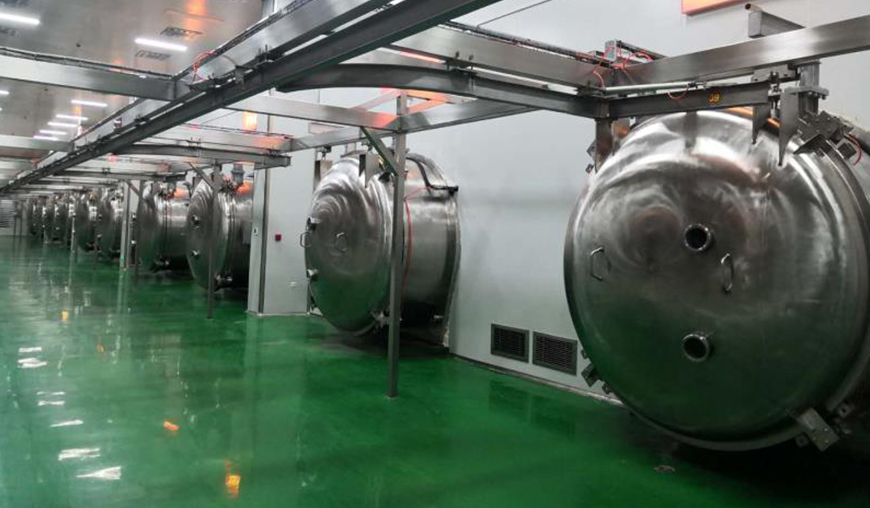
A freeze dryer for ready-to-eat meal production is specialized industrial equipment designed
to preserve fully cooked meals by removing water under low temperature and vacuum.
In the ready meal industry, freeze drying offers long shelf life, clean labeling,
and excellent rehydration quality compared with many conventional drying methods.
This guide provides an in-depth, SEO-friendly overview of industrial freeze dryers
for ready-to-eat (RTE) meal production, covering principles, benefits, process flow,
technical specifications, and key design considerations.
A freeze dryer (also called a lyophilizer) for ready-to-eat meals is a
large-scale food processing machine that removes moisture from cooked meals by sublimation.
Meals are first frozen and then dried under deep vacuum so that ice in the food
converts directly from solid to vapor without passing through the liquid phase.
This process preserves the original structure, taste, color, and nutritional value
of ready-to-eat dishes.
In the context of ready-to-eat meal production, freeze dryers handle:
Industrial freeze dryers for RTE meals are engineered for:
Freeze drying is one of the most advanced preservation methods for ready-to-eat meals.
Compared to conventional dehydration, canning, or retort processing,
freeze drying offers multiple benefits that are critical for premium
ready meal brands and long-shelf-life applications.
| Advantage | Description for RTE Meal Production |
|---|---|
| Superior product quality | Maintains original flavor, aroma, color, and texture after rehydration; ideal for high-quality ready meals. |
| High nutrient retention | Low-temperature drying reduces loss of vitamins, proteins, and sensitive nutrients common in high-heat methods. |
| Extended shelf life | Very low final moisture content and water activity enable shelf life from 1 to 25+ years, depending on packaging and storage. |
| Lightweight products | Water removal greatly reduces weight, lowering shipping costs for ready meals in e-commerce and export markets. |
| Fast and easy rehydration | Porous structure allows meals to rehydrate quickly with hot water; convenient for consumers and food service. |
| Minimal additives | Low water activity enables reduced use of preservatives; supports clean-label, natural ingredient claims. |
| Shape and structure preservation | Meals retain original shapes (e.g., vegetable cubes, meat pieces, pasta), improving visual appeal. |
| Cold chain independence | Freeze-dried ready meals are shelf-stable at ambient temperature, reducing need for refrigeration or freezing. |
A freeze dryer for ready-to-eat meal production operates in several stages.
Each stage must be tailored to the specific meal formulation and packaging format
to ensure optimal drying and product quality.
Ingredients are prepared, cooked, and assembled as a complete ready-to-eat meal.
This may include:
Meals are frozen to low temperatures (typically -30°C to -50°C) to form solid ice crystals.
Uniform and rapid freezing is critical for maintaining structure and ensuring consistent
drying performance throughout the batch.
Frozen meals, usually in stainless-steel trays, racks, or on belt systems,
are loaded into the freeze dryer chamber. Proper spacing is important
for uniform heat transfer and vapor removal.
During primary drying, pressure in the chamber is reduced to a deep vacuum,
and heat is gently supplied via heated shelves or plates.
Ice directly transforms from solid to vapor (sublimation) without melting.
This stage removes most of the moisture (around 90%–95% of the water content).
After most ice is removed, the product temperature is gradually increased
while continuing vacuum to remove unfrozen and bound water.
This stage reduces final moisture content to the target level and
lowers water activity to ensure microbiological stability.
Once the target moisture and water activity are reached,
the product is cooled (if necessary), and the chamber is brought back to near-atmospheric pressure.
Oxygen- or nitrogen-flushing may be applied to protect sensitive meals.
Freeze-dried ready meals are unloaded and transferred to
moisture- and oxygen-barrier packaging, such as:
| Stage | Typical Equipment | Key Objectives |
|---|---|---|
| 1. Raw material handling | Washers, cutters, mixers | Prepare ingredients with consistent size and quality. |
| 2. Cooking and assembly | Cookers, kettles, ovens, fillers | Create fully cooked, portioned ready-to-eat meals. |
| 3. Pre-freezing | Blast freezers, plate freezers | Rapidly freeze meals to protect structure and minimize ice crystal damage. |
| 4. Freeze drying | Industrial freeze dryer (lyophilizer) | Remove water via sublimation and desorption under vacuum and controlled heat. |
| 5. Post-drying handling | Conveyors, inspection, metal detectors | Protect product integrity and ensure safety. |
| 6. Packaging | Form-fill-seal machines, pouch packers | Seal meals in moisture- and oxygen-barrier packaging for long shelf life. |
| 7. Storage and distribution | Ambient warehouses, logistics | Deliver shelf-stable freeze-dried meals to markets worldwide. |
A freeze dryer for ready-to-eat meal production consists of several
critical subsystems. Each component influences performance, energy efficiency,
and product quality.
When selecting a freeze dryer for ready meal production,
manufacturers consider a range of technical parameters.
The following tables summarize typical specification areas and example values
for industrial-scale equipment. Actual specifications vary widely depending on capacity,
technology, and project requirements.
| Parameter | Typical Range | Relevance for Ready-to-Eat Meals |
|---|---|---|
| Installed shelf area | 5 m² to 200+ m² | Determines how many trays or meal portions fit in one batch. |
| Batch loading capacity | 50 kg to several tons (wet weight) | Defines daily or per-cycle production volume of ready meals. |
| Production per cycle | Equivalent dry weight after water removal | Helps calculate cost per meal and throughput. |
| Number of cycles per day | 1 to 3+ cycles, depending on cycle time | Impacts total daily production capacity. |
| Parameter | Typical Range | Role in Freeze Drying |
|---|---|---|
| Shelf temperature during freezing | -40°C to -60°C | Ensures complete solidification of water in meals before sublimation. |
| Shelf temperature during primary drying | -30°C to +30°C (controlled ramp) | Balances sublimation rate against risk of product melting or collapse. |
| Shelf temperature during secondary drying | +20°C to +60°C | Removes bound water and achieves target residual moisture. |
| Chamber operating pressure | Typically 0.05 to 1.0 mbar (5 to 100 Pa) | Maintains environment where sublimation occurs efficiently. |
| Condenser temperature | -40°C to -80°C | Captures water vapor from product and maintains vacuum performance. |
| Utility | Typical Requirement | Considerations for Plant Design |
|---|---|---|
| Electrical power | From tens of kW to several hundred kW | Drives refrigeration, vacuum pumps, controls, and auxiliary equipment. |
| Cooling water or chiller capacity | Required for refrigeration condensers and possibly pump cooling | Impacts choice of cooling system and infrastructure design. |
| Compressed air | For valves, actuators, and automation | Standard factory air systems usually sufficient at 6–8 bar. |
| Steam or hot water (optional) | If using steam-heated shelves | Requires boiler or heat source integration. |
| Quality Parameter | Typical Target for RTE Freeze-Dried Meals | Impact on Product |
|---|---|---|
| Final moisture content | 1%–5% (product-dependent) | Lower moisture improves shelf life but must balance texture and rehydration. |
| Water activity (aw) | <0.3 (commonly) | Ensures microbiological stability and prevents spoilage. |
| Rehydration time | 5–15 minutes with hot water | A key consumer experience metric for ready-to-eat meal convenience. |
| Nutrient retention | High retention compared with conventional thermal processes | Supports nutritional claims for proteins, vitamins, and minerals. |
| Texture after rehydration | Similar to freshly cooked meal | Critical differentiator for premium ready-to-eat meals. |
Multiple types of freeze dryers can be adapted for ready-to-eat meal production.
The choice depends on batch size, product format, and investment constraints.
Freeze dryers for ready meal production can handle a wide range of product types and cuisines.
Proper design of meal composition, portion geometry, and packaging is essential for
consistent freeze drying performance.
For freeze dryer for ready-to-eat meal production operations,
the physical form of the meal influences drying efficiency and rehydration quality:
To achieve consistent, high-quality freeze-dried ready-to-eat meals,
manufacturers must carefully optimize the freeze drying cycle for each recipe.
| Monitoring Parameter | Purpose | Importance in RTE Meal Freeze Drying |
|---|---|---|
| Product temperature | Ensure product stays below critical collapse temperature. | Prevents loss of structure and appearance in ready meals. |
| Chamber pressure | Maintain optimal conditions for sublimation. | Improves drying efficiency and cycle time. |
| Shelf temperature | Control heat input to product. | Fine-tunes drying profile for different meal recipes. |
| End-point detection | Determine when moisture content reaches target. | Avoids over-drying or under-drying, optimizing energy and quality. |
Selecting the right freeze dryer for ready-to-eat meal production
involves evaluating technical, operational, and economic factors.
Food manufacturers using freeze dryers for ready-to-eat meal production
must comply with food safety regulations and industry standards.
While freeze drying offers clear advantages for premium ready-to-eat meals,
it also has limitations that manufacturers must consider in their business models.
| Aspect | Benefit in Ready Meal Production |
|---|---|
| Product quality | Excellent sensory quality, high nutrient retention, attractive appearance. |
| Shelf life | Long shelf life without refrigeration, ideal for global distribution. |
| Convenience | Fast rehydration and simple preparation with water. |
| Logistics | Low product weight and volume lower shipping and storage costs. |
| Marketing | Supports clean-label, premium, and specialized nutrition product positioning. |
Despite these limitations, for high-value, long-shelf-life, and quality-sensitive ready meals,
a freeze dryer for ready-to-eat meal production is often the preferred technology.
Packaging is a crucial part of the freeze-dried ready meal production line.
The benefits achieved during freeze drying must be protected throughout storage and distribution.
| Factor | Influence on Shelf Life |
|---|---|
| Residual moisture and water activity | Lower values generally extend shelf life by limiting microbial growth and chemical reactions. |
| Oxygen exposure | Higher oxygen increases risk of oxidation, color changes, and off-flavors. |
| Storage temperature | Cool, stable temperatures provide longest shelf life; extreme heat accelerates degradation. |
| Light exposure | Light-sensitive components require opaque or UV-blocking packaging. |
Implementing a freeze dryer for ready-to-eat meal production
requires careful planning of installation, commissioning, and operation.
Energy use and environmental impact are increasingly important for ready meal manufacturers.
Modern freeze dryers for ready meal production are designed
with energy efficiency and sustainability in mind.
The following checklist summarizes key points to evaluate when choosing
a freeze dryer for ready-to-eat meal production:
| Category | Key Questions |
|---|---|
| Capacity | What is the required daily/annual output? How many SKUs? Do you anticipate future expansion?
|
| Product | What meal types, compositions, and formats will be processed? What are moisture and water activity targets?
|
| Cycle performance | What cycle times are acceptable? How will you validate and optimize drying profiles?
|
| Utilities | Are sufficient power, cooling, and air supplies available? What are the energy cost implications?
|
| Hygiene | Does the design support your sanitation program and food safety requirements?
|
| Automation | How automated should loading, recipe control, and data logging be?
|
| Cost | What is your acceptable range for CAPEX and OPEX? What is the projected return on investment?
|
Freeze dryers are central to the production of high-quality, long-shelf-life
ready-to-eat meals. By gently removing water at low temperatures
under vacuum, freeze drying preserves:
For manufacturers targeting premium markets, outdoor and emergency food,
and long-distribution supply chains, investing in a well-designed
freeze dryer for ready-to-eat meal production can create
significant competitive advantages. Thoughtful selection of equipment,
careful design of meal formulations, and optimization of freeze drying cycles
enable consistent, safe, and appealing freeze-dried ready meals that meet
modern consumer expectations around quality, convenience, and sustainability.
```
Этот веб-сайт использует файлы cookie, чтобы обеспечить вам максимально эффективное использование нашего веб-сайта.
 English
 Español
 Français
 العربية



 WhatsApp
 телефон
Комментарий
(0)